 Explore BubbleTubing.com
  Aeration
  Deicing
  Floating Fountains
  Bioaugmentation
  Aquatic Tools
  Bubble Curtains
 Control of Water Milfoil
🔎 Looking for information about Eurasian watermilfoil?
For Eurasian watermilfoil specifically, our current recommendation is ProcellaCOR FX — a selective, low-dose treatment registered for aquatic use in Canada (2023) that targets milfoil directly, roots included.
→ Eurasian Water Milfoil Control with ProcellaCOR FX
→ Milfoil FAQ & resources
Our article on invasive aquatic plants covers several ways to address invasive species in your pond or along your shoreline. However, water milfoil – also called zombie plant – deserves special attention because of its particularly aggressive nature.
Aeration, circulation and beneficial bacteria can help manage nutrient-driven aquatic plant growth. On their own they are not a reliable control for an established Eurasian watermilfoil infestation — for that, see the note above.
Step 1: Use a benthic barrier on small, defined areas
If you have time and energy, a very useful step would be to apply a benthic barrier over the plants in the spring for about 4 weeks. Benthic barriers are also known as synthetic membrane, fibreglass membrane or jute barrier. We offer two versions of this product: the Lake Bottom Blanket or the Aquascreen. Over about four weeks the cover blocks light and kills the plants directly beneath it, clearing that patch. The tarp can then be moved to treat another spot. A benthic barrier is best suited to small, well-defined areas — around a dock, ladder or swimming zone — not as a lake-wide milfoil solution.
Remember: if you manually dig up the plants, do not dispose of them in your compost bin or compost site. This is an invasive plant that has to be sent to the landfill.
Step 2: Aeration & Circulation
Generally, our bottom aeration systems consist of three components, placed one after the other:
- A compressor, powered by electricity or solar energy;
- Weighted tubing carrying compressed air to the aeration devices;
- Aeration devices: either individual round diffusers or linear Bubble Tubing® diffusers.
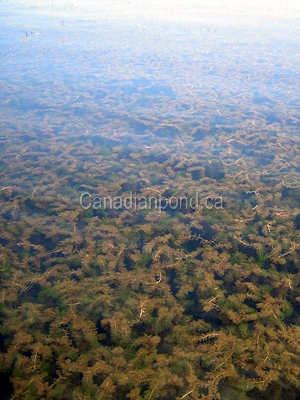 These aeration systems emit thousands of tiny bubbles that rise to the surface and draw a column of water upward. This adds oxygen and creates continuous water movement. The amount of water circulated depends on the water depth and the type of diffuser used. The result is well-oxygenated water circulating through a Milfoil bed.
aerating fountains can provide additional water movement and circulation. In other situations, Kasco circulators may help manage sediment accumulation.
A system must be designed to the specific needs of each location, allowing for individual conditions such as:
- Density of Milfoil growth
- Size of area to be cleared
- Lake bottom condition – bottoms of Milfoil beds are usually made up of decaying organic matter – silt and muck.
- Water depth
Let’s take a typical system as an example. Let’s say we have a cottage with an extensive water milfoil bed at the water’s edge – the bed is 60 feet wide on the bank and extends up to 60 feet long in the water – a total of 3,600 square feet to be treated. Milfoil growth is dense, the bottom is extremely muddy, and the average depth is 10 feet. This situation would require two 50′ lines of Bubble Tubing®, each circulating water for 15 feet on either side. This produces a much less attractive environment for milfoil, which appreciates stagnant water. The cost of the system would be close to $3,000 if you install it yourself (the installation is very simple but, if in doubt, can be done by us). You will also need to budget for the addition of beneficial bacteria. Keep in mind that 3,600 square feet is a fairly large surface area, probably larger than what most cottagers would have to clear.
Step 3: Bacteria
After aeration and circulation are established, beneficial bacteria can be added. Our specialized bacteria help accelerate the decomposition of organic matter on the pond bottom and use oxygen to reduce sediment thickness. The sediment releases nutrients back into the water, providing a prime substrate for the establishment of milfoil. Use Bacterius® MUCK for your lakefront, or Bacterius® 5B for your pond.
How does it work?
Milfoil requires an abundant supply of nutrients, or it dies. Fundamentally, the system operates by starving the Milfoil of nutrients. It does this in several ways:
- Circulating water attracts and holds some of the lake nutrients, thus depriving the Milfoil of some of its food availability.
- Well-oxygenated water acts to oxidize the bottom muck so there is not the usual release of nutrients. Bacteria catalyze these reactions.
- As the Milfoil thins out, other water plants, which were previously crowded out by the aggressive growth of the Milfoil, start to reappear and improve biodiversity.
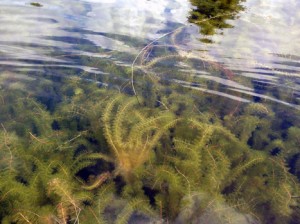
The annual Milfoil growth cycle starts in the spring / early summer as the water starts to warm up. Growth, as most of us well know, is rapid and extensive through the summer and early fall. As temperatures fall, stems and surface mats die back and reserves are stored in the roots for winter survival and spring growth. Aeration and circulation can extend the growing season of above-water growth and leave roots with fewer stored reserves before freeze-up.
A word of caution: the aeration, circulation and bacteria approach described here manages water quality and nutrient loading. It is not a milfoil eradication program, and on its own it will not reliably clear an established Eurasian watermilfoil infestation. For milfoil control specifically, see ProcellaCOR FX.
Despite its possible slowness, there are definite advantages that compensate for the deployment of the aeration-circulation-bacteria approach. To name a few:
If we consider the concrete benefits – being able to swim in front of the cottage, getting the boat out without having to clean the propeller, etc. – the cost of purchasing and operating the system is probably worth it.
Once running, the system needs little day-to-day attention and supports general water quality and shoreline access. On its own it will not keep an area clear of established milfoil.
System maintenance is easy; simply plug in the compressor in the spring and unplug in November. Caution! You cannot operate the system once the ice starts to form, because you will have a very dangerous ice-free area for surface traffic such as ATVs, snowmobiles, etc.
The process is lake-friendly. It helps move from a eutrophic state, rich in nutrients supporting abundant plant growth including Milfoil and algae, to an oligotrophic state, scarce in nutrients and plant growth. These are the conditions normally found in a lake with a steep rocky shoreline and clear deep water.
If you have questions about these methods, or about milfoil control options including ProcellaCOR FX, or wish to talk about a system for your cottage and get a specific quote, don’t hesitate to contact us.
Related content:
- La semaine verte | Myriophylle : L’envahisseur marin | ICI TOU.TV (Video; in French)
- Maine Citizen’s Guide to Invasive Aquatic Plant Management (PDF) by MVLMP (Maine Volunteer Lake Monitoring Program)