 Click here to visit Bubbletubing.com
  Aeration
  Deicing
  Floating Fountains
  Bioaugmentation
  Aquatic Tools
  Bubble Curtains
 Degradation of Organic Matter by Aeration
 The municipality of Saint-Pie, located in Montérégie, draws its drinking water from a 11,7-acre natural reservoir nestled at the top of Mont-Yamaska. Since 2004, the town’s filtration plant had recorded levels of Manganese above the limits set by Health Canada for drinking water. It is this initial reason that led the municipality to install an aeration system with an Octo-Air diffuser in 2007. Although the benefits on water quality have already been reported in this article, another beneficial effect of aeration was the drastic disappearance of the layer of organic matter accumulated at the bottom of the reservoir.
In fact, a diver had inspected the water intake in 2006, the year before the diffuser was installed. This intake consists of a horizontal pipe placed 15 feet (6.8 m) from the bottom of the reservoir. At the time of this inspection, the muck had reached a thickness of almost 15 feet, as it was almost touching the intake. Years of leaf litter accumulation in the reservoir was slowly filling it up. To preserve the function of the reservoir, it would have been necessary to dredge the bottom with heavy machinery.
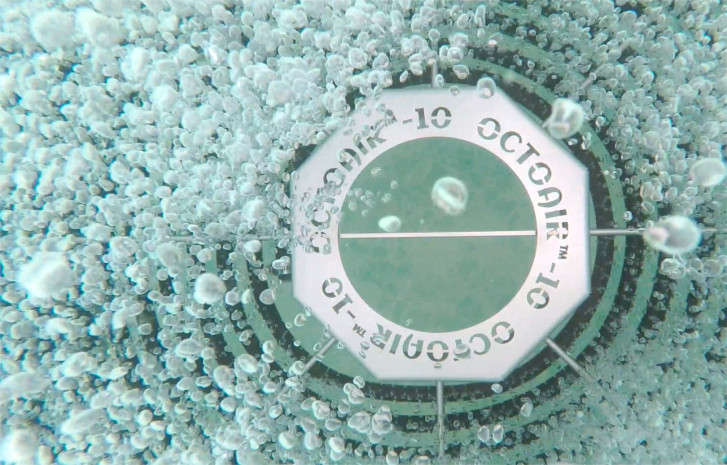 However, what a surprise it was for this same diver when in 2011 – after 5 years of aeration with one OctoAir, he observed that the organic matter had completely disappeared! The bottom of the tank had returned to gravel, and there was once again 15 feet of open water between the water intake and the bottom! The aeration had provided the oxygen necessary for the sediment microflora to break down the cellulose from the leaves and other detritus more quickly, which was not possible when the bottom had a lack of oxygen.
This anecdote illustrates that aeration can be a critical aspect for maintaining the health of a water body. In this case, significant costs were saved by eliminating this layer of muck, which would have required a very costly operation for taxpayers and would have been very damaging to the shoreline and the aquatic environment.
To this day, the aeration system continues to perform its dual function of water purification and natural reservoir maintenance.
Please note that muck reductions in a water body are dependent on many factors, such as water depth, nutrient supply, your type of water body, water temperature, etc. Therefore, the results observed in your water body may vary from those observed in the community of St-Pie.
Other interesting articles: